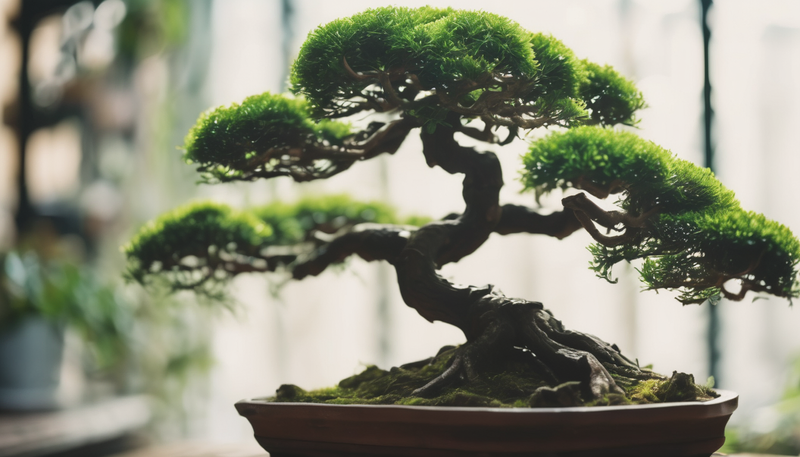
What is Bonsai?
A small tree telling a big story...

Imagine standing at the edge of a windswept coast.
The trees grow sideways, bent and twisted, all leaning in the same direction. What would a miniature tree from this place look like? It would carry that lean, that struggle against the wind, in every line of its trunk and branches.
Imagine walking through a mountain pass in deep winter.
Heavy snow has pressed the branches down year after year, bending them low, weighing them with memory. What would the miniature version show? Burdened branches that tell of long endurance under the weight of the seasons.
Imagine a quiet temple courtyard in spring.
The cherry blossoms open all at once, breathtaking and brief, petals drifting away in days. What would the miniature tree say? It would remind us that beauty is precious not because it lasts, but because it doesn’t.

LIFE IN MINATURE
From the very beginning, humans have tried to bring the vastness of life closer through the miniature. Ice Age carvers shaped tiny ivory animals. Egyptians placed model boats and farms in tombs. Even today we delight in model trains, toy cars, and video games—miniaturized worlds that let us step into life on a smaller scale.At its heart, bonsai is the art of making the small feel big, and the big intimate.
Much of human art begins this way: cave paintings shrink herds into the reach of a wall; an epic poem condenses lifetimes of struggle into a stanza; a photograph captures an eternity of meaning in a fraction of an instant. Everywhere, in every age, we have miniaturized experience to make it graspable, to turn awe into something small, containable, and portable.
Like other arts, bonsai imitates, depicts, and describes its subject—a tree. But bonsai is not just a representation of a tree. It is a tree. And in its reduced form it suggests more than itself: the full-sized trees it evokes, the forces of nature that shaped them, the centuries they have endured.

TREES TELLING STORIES
Trees are among the oldest beings on Earth. They gave us the air we breathe, shaded the ground where we evolved, and hold the memory of seasons and centuries in their rings. To see a tree is to glimpse time on a scale larger than ourselves. A bonsai carries that same story—a story of place and of time and of what it means to be alive—condensed into a single living form.
A pine twisted by coastal winds speaks of endurance, standing firm through hardship. A maple that blazes in autumn and then sheds to bare bones shows us that change and loss are part of life’s rhythm. A plum blooming after snow reminds us of resilience—beauty and renewal after adversity. A cherry, brilliant and brief, teaches us to treasure fleeting joys. A juniper clinging to stone embodies patience and persistence, surviving where it seems impossible.
These trees are not only landscapes made small. They are reflections of human life—our struggles, our seasons, our endurance over time. Bonsai carries those lessons in living form, growing and changing as we do, a companion that holds the universe in miniature.

THE CULTURAL STORY OF BONSAI
Humans have been potting plants for millennia, but the cultivation and design of potted trees has its strongest roots in China. As Rome rose over the Mediterranean and indigenous people tracked bison across the plains of what is now the United States, Han dynasty (206 BCE–220 CE) artists in China created penjing—miniature landscapes that suggested entire worlds in a tray. A mountain stone, a water pool, a few twisted trees—each was a cosmos in miniature, an opportunity to contemplate from the perspective of the gods.
When penjing reached Japan, it was distilled further and renamed bonsai: at once a plain description—“plant in a shallow tray”—and at the same time something bigger - the start of a new art form and aesthetic lineage that endures to this day.
The landscape fell away and the tree itself became the subject. A single pine could now imply a windswept cliff; a maple in autumn could stand for a whole valley.
Over centuries, Japan developed styles, proportions, and principles of display. Bonsai became a cultural practice of discipline and refinement, admired not only for horticultural skill but also for its rules and philosophy: impermanence, asymmetry, and the beauty of the unseen.

BONSAI IN THE U.S.
Bonsai came to America in fragments: displays at world’s fairs, nurseries run by Japanese immigrants, books and lectures on the East Coast, backyard practice on the West. After the Second World War it spread more widely—anchored by public gardens, gifts of historic trees, and eventually apprenticeships in Japan that brought new rigor back to American soil.
Today, bonsai in America is still finding itself. We inherit Japanese standards, but we also face American landscapes, species, and values. The art here cannot look identical to bonsai in Japan—nor should it.
A bald cypress in Florida tells a different story than a Japanese black pine. A Sierra juniper speaks differently than a Shimpaku from Shikoku. A New England red maple carries another voice altogether from a kiyohime in Kyoto.
Similarly, the culture of bonsai in America cannot simply mirror that of Japan. In Japan, bonsai has centuries of refinement behind it, and customers often value continuity, tradition, and the quiet perfection of form. In America, people often come to bonsai seeking personal expression, accessibility, and connection to the landscapes they know. That difference is not a weakness—it is the natural evolution of an art adapting to new soil.
What connects us across cultures and centuries is the same human impulse: to make something small that feels vast, to let a single tree suggest an entire world.
Bonsai outside Japan is still being figured out, and part of my goal is to guide that process: to share history, offer principles, and help shape a culture of bonsai that feels authentic to its place and time.